Background
Ralf Nelson Elliott was an American accountant and author born in Marysville, Kansas in 1971. Elliott studied the stock market data which directed him to build up the ‘Elliott Wave Principle’. In his study he projected that the market prices follow particular patterns. He published his theory in 1938 in his book called ‘The Wave Principle’ and in later stages he supported and enhanced that theory by publishing articles such as the ‘Nature Law’ in 1942 and ‘The Secret of the Universe’ in 1946.
“because man is subjected to rhythmical procedure, calculations having to do with his activities can be projected far into the future with a justification and certainty heretofore unattainable.”
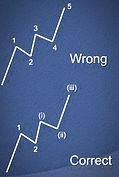
Additionally, Robert Prechter in the 1970’s, promoted the Elliott Wave Theory in the investing communities making it popular. In essence, Elliot identified that markets move 5 waves in the impulsive direction and 3 waves in the corrective direction.
-
Points 1, 3 and 5 are impulsive and they move in the trend’s direction.
-
Points 2 and 4 are corrective and usually do not violate the starting point of the previous impulsive wave.
Elliott Theory Summary
Market fluctuations are due to Impulse Waves and Corrective Waves.
The impulse wave moves against the trend and creates 5 sub-waves and the corrective wave moves against the trend and creates 3 sub-waves.
Additionally, we have also waves within waves where forecasts can be made by counting waves in the long term to short term charts.
The second wave should not overpass the beginning of the first wave.
Wave Counting

The third wave should not be the shortest among the first, third and fifth wave.
There should not be any overlapping between the forth and second wave, unless in diagonal triangle.

The Rule of alteration identifies that the second and forth seize changed wave forms.

3 Wave Forms in Impulse Wave
Extension
-
Either the first, third or fifth wave will noticeably extend.
-
The third wave would not be the shortest among the first, third and fifth wave.

Four simple structures
Corrective Wave Structure


3. Irregular
4. Horizontal Triangle

1. ZigZag
2. Flat


-
Fifth wave failed to exceed the third wave end.
-
Fifth wave takes a structure of 5-3-5-3-5
-
Failure to have the momentum to breath into new high/low before reversal
Fifth wave extension


-
Wave structure in upwards or downwards diagonal triangle.
-
In the form of contracting or expanding triangle.
-
The sub-waves in the diagonal triangle take the structure of 3-3-3-3-3.
-
If diagonal triangle comes up at the first wave, it will take the structure of 5-3-5-3-5.
-
The second and the forth sub-wave will overlap.
Diagonal Triagle


The Elliot Wave Principle

Financial
Indicators





Featured Brokers
